
Blog
Why Altitude Affects Traditional Biltong Air-Curing in Different South African Regions

The Science Behind Altitude and Air-Curing
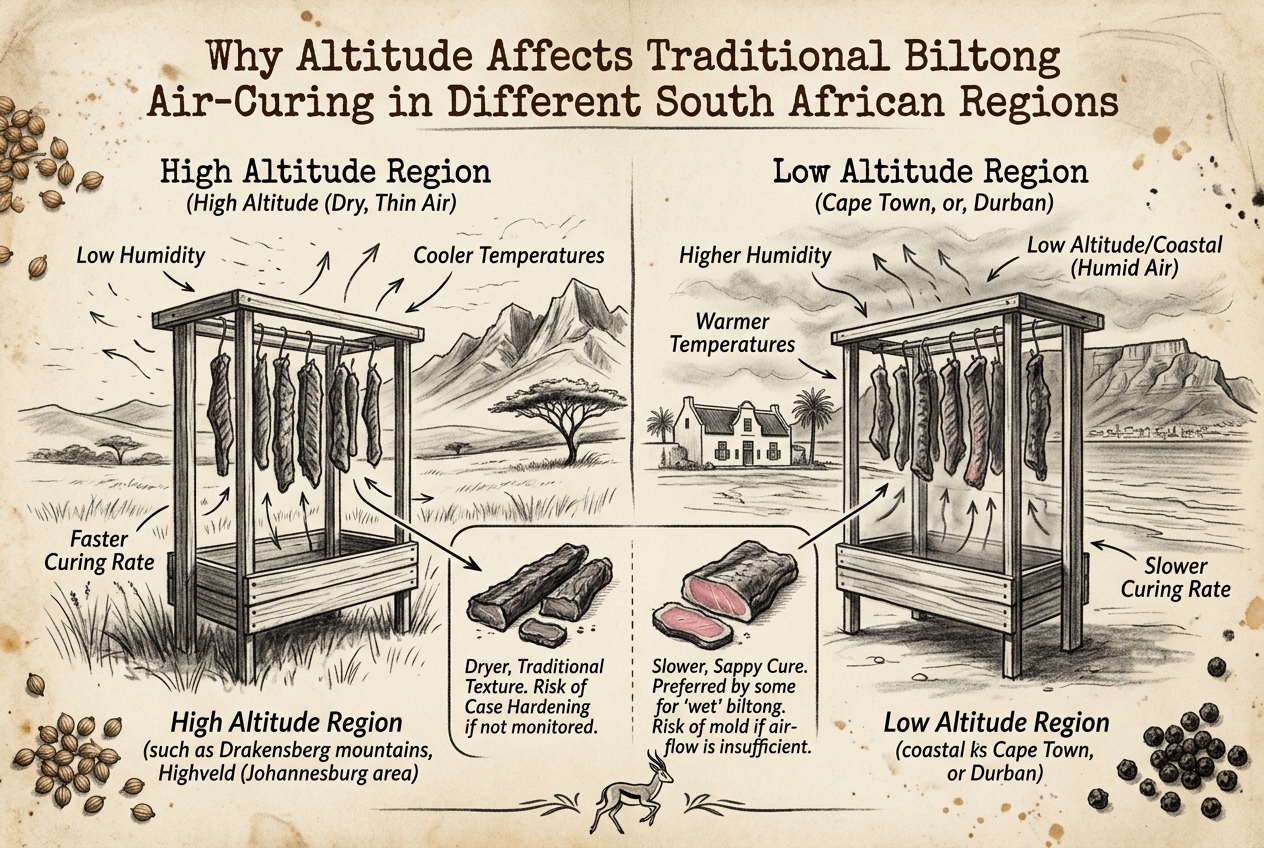
Picture this: a traditional biltong maker in Johannesburg produces perfectly dried strips in five days, while their cousin in Cape Town needs eight to ten days for the same result using identical methods. The culprit? Altitude. What seems like a simple difference in elevation creates a complex web of atmospheric changes that fundamentally alter how moisture leaves meat during the air-curing process.
The relationship between altitude and air-curing isn’t just academic curiosity. For anyone serious about producing consistent South African beef biltong, understanding these atmospheric variables means the difference between perfectly textured biltong and disappointing results that waste quality meat and time.
Traditional biltong makers have intuitively understood these differences for generations, adjusting their methods based on local conditions. Modern producers, however, benefit from understanding the precise science behind why altitude creates such dramatic changes in drying behavior.
How Air Pressure Changes Affect Moisture Evaporation
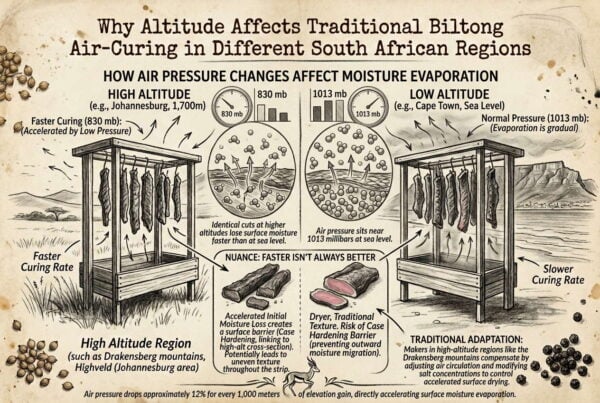
Comparison of how altitude affects biltong air-curing, showing faster drying at high elevations and slower, even curing at sea level in South Africa.
Air pressure drops approximately 12% for every 1,000 meters of elevation gain, creating a cascade of effects on moisture evaporation. At sea level locations like Cape Town, atmospheric pressure sits near 1013 millibars. Compare this to Johannesburg at 1,700 meters, where pressure drops to roughly 830 millibars.
Lower atmospheric pressure directly accelerates moisture evaporation from meat surfaces. Water molecules require less energy to transition from liquid to vapor phase when surrounding air pressure decreases. This means biltong strips at higher altitudes lose surface moisture faster than identical cuts at sea level.
But here’s where it gets interesting: faster initial moisture loss doesn’t necessarily mean better biltong. Rapid surface drying can create a moisture barrier that prevents deeper moisture from migrating outward, potentially leading to uneven texture throughout the strip.
Traditional makers in high-altitude regions like the Drakensberg mountains compensate by adjusting air circulation patterns and sometimes modifying salt concentrations to control this accelerated surface drying.
Temperature Variations at Different Elevations
Temperature drops predictably with altitude at roughly 6.5°C per 1,000 meters of elevation gain. This temperature differential significantly impacts enzyme activity and chemical processes during air-curing.
Cooler temperatures at higher altitudes slow down natural enzyme reactions that contribute to flavor development in traditional air-curing. These enzymes break down proteins into amino acids and create the complex flavor compounds that distinguish properly made biltong from simple dried meat.
The temperature difference also affects how spices penetrate the meat. Coriander, black pepper, and other traditional seasonings release their flavor compounds more slowly in cooler conditions, requiring longer contact time or adjusted spice ratios to achieve the same flavor intensity.
Interestingly, cooler temperatures at altitude can actually benefit preservation by slowing bacterial growth, creating a wider safety margin during the critical first 24-48 hours of the curing process.
Humidity Levels and Their Impact on Drying Times
Humidity levels vary more by regional climate than altitude alone. While many high-altitude regions in South Africa experience lower humidity and faster drying conditions, mountainous areas can also experience localized moisture patterns that affect curing times.
Higher humidity significantly extends drying times. Moisture-saturated air cannot accept additional water vapor from drying meat as readily, creating a bottleneck in the dehydration process. This explains why biltong production in humid coastal regions often requires different timing than production in drier inland areas.
The humidity factor becomes particularly complex during weather pattern changes. Mountain regions experience rapid humidity fluctuations that coastal areas rarely see, requiring more careful monitoring and potentially adjustable drying environments.
Traditional producers often use natural windbreaks or adjust hanging positions to work with prevailing humidity patterns rather than fighting them.
Why Traditional Methods Need Adjusting at Higher Altitudes
The convergence of pressure, temperature, and humidity changes means traditional sea-level methods rarely translate directly to high-altitude production. Salt concentrations that work perfectly in coastal regions can over-cure meat at altitude, where faster initial moisture loss concentrates the salt solution more quickly.
Air circulation requirements also change dramatically. Thinner air at altitude carries less thermal mass, requiring adjusted ventilation patterns to maintain consistent drying conditions. Traditional hanging methods might need modification to account for different air movement patterns.
Timing becomes one of the most critical adjustments. What coastal producers accomplish in five days might require only three days at higher altitude, not just because of faster overall drying, but because the quality development processes happen at different rates.
These adjustments aren’t one-size-fits-all solutions. Each elevation range requires specific modifications based on the unique combination of atmospheric conditions at that altitude.
Regional Differences Across South Africa’s Landscape
Coastal Regions vs Inland Plateau Conditions
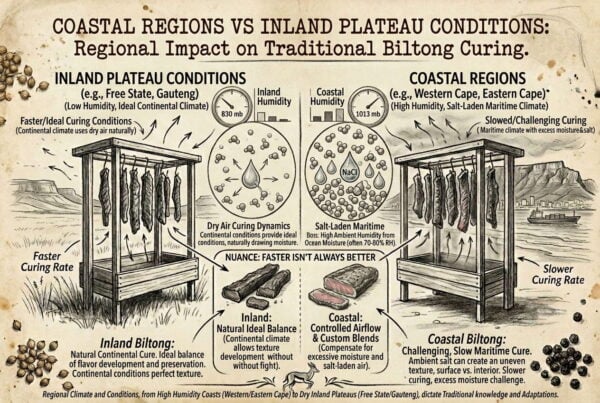 The dramatic differences between South Africa’s coastal regions and inland plateau create two completely different worlds for traditional air-curing. Coastal areas like the Western and Eastern Cape face the constant challenge of high humidity from ocean moisture, often reaching 70-80% relative humidity during certain seasons. This excess moisture can slow the curing process significantly, sometimes extending drying times from the typical 4-7 days to nearly two weeks.
What’s particularly challenging about coastal curing is the salt-laden air. While salt is beneficial for preservation, ambient salt in coastal air can create an uneven curing environment where the surface of the meat develops a different texture than the interior. Traditional biltong makers in Cape Town have learned to compensate by adjusting their spice blends and creating more controlled airflow systems.
Inland plateau regions present the opposite scenario. Areas like the Free State and parts of Gauteng benefit from lower humidity levels, typically 30-50%, and more consistent temperature patterns. The continental climate creates ideal conditions where South African beef can develop its characteristic texture without fighting against excess moisture. Dry air naturally draws moisture from the meat fibers, creating that perfect balance between preservation and flavor development.
Mountain Areas and Their Unique Challenges
Mountain regions across South Africa, particularly the Drakensberg and areas around Lesotho, introduce altitude as a critical factor that many people don’t consider. At elevations above 1,500 meters, air pressure drops significantly, affecting how moisture evaporates from meat during the curing process.
The thinner air at altitude accelerates moisture loss initially, but it can create problems with uneven drying. The exterior of the meat may form a protective crust too quickly, trapping moisture inside and potentially leading to spoilage. Traditional biltong makers in mountainous regions have developed techniques to slow down the initial drying phase, often using cloth wrappings or controlling airflow more precisely.
Temperature fluctuations in mountain areas also present challenges. Dramatic day-night temperature swings, sometimes exceeding 20°C, can cause the meat to expand and contract, affecting the fiber structure. However, these same conditions can create incredibly complex flavors when managed properly, as varying temperatures allow different enzymatic processes to occur at different rates.
Karoo Desert Climate Advantages
The semi-arid Karoo region represents perhaps the most ideal natural environment for traditional biltong air-curing. The combination of low humidity, often below 30%, consistent temperatures, and natural airflow creates conditions that closely mirror what commercial producers try to achieve in controlled environments.
What makes the Karoo special is its remarkable consistency. Unlike coastal areas with humidity swings or mountain regions with temperature extremes, the Karoo maintains steady conditions for weeks at a time. This allows for predictable curing times and consistent results batch after batch.
The dry air of the Karoo also prevents the growth of unwanted bacteria and molds that can plague biltong production in more humid climates. Traditional producers in this region often report that their biltong develops a deeper, more concentrated flavor profile because the slow, steady moisture extraction allows amino acids and natural enzymes more time to break down proteins and develop complex tastes.
Highveld vs Lowveld Curing Environments
The distinction between South Africa’s Highveld and Lowveld regions creates two distinctly different curing environments, each with its own advantages and challenges. The Highveld, encompassing areas around Johannesburg and Pretoria at elevations around 1,500-1,800 meters, offers cooler temperatures and lower humidity that generally favor traditional air-curing methods.
Highveld conditions typically maintain temperatures between 15-25°C with humidity levels around 40-60%, creating an environment where moisture extraction happens at an optimal rate. Cooler temperatures prevent rapid surface drying while still allowing steady moisture loss throughout the meat structure.
The Lowveld regions, including areas like the Kruger Park vicinity and eastern Mpumalanga, present warmer, more humid conditions that require careful management. Temperatures often reach 25-30°C with higher humidity levels, which can accelerate spoilage risk if not properly controlled.
Traditional producers in Lowveld regions have adapted by curing during cooler months and using enhanced ventilation techniques. They often achieve excellent results by working with seasonal patterns and timing production to coincide with dry winter months.
Adapting Traditional Techniques for Your Location
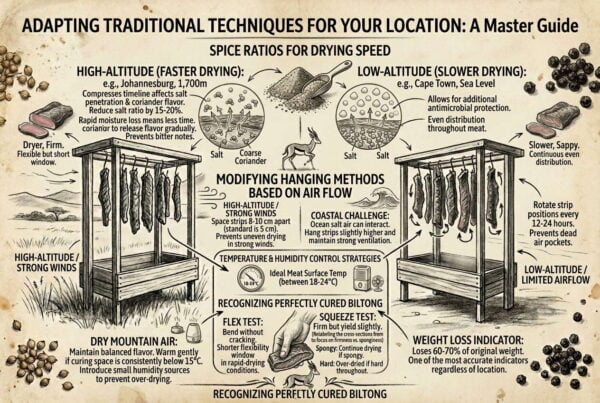
Infographic showing how altitude, humidity, and airflow affect biltong drying and curing for optimal flavor and texture.
Adjusting Spice Ratios for Faster or Slower Drying
Your spice blend needs to work harder or gentler depending on how quickly moisture leaves your meat. In high-altitude areas where drying accelerates, typically above 900 meters, you’re dealing with a compressed timeline that affects how salt penetrates and coriander develops its signature flavor profile.
When air-curing happens faster, reduce your salt ratio by about 15-20%. Rapid moisture loss means salt doesn’t need as much time to work through the muscle fibers. Too much salt in fast-drying conditions creates an overly concentrated surface that can inhibit proper enzyme activity underneath.
Conversely, in slower-drying environments like coastal regions or lower elevations, increasing salt content slightly provides additional antimicrobial protection and allows more even distribution throughout the meat.
Coriander responds differently to drying speed too. In rapid-drying conditions, use coarsely cracked coriander rather than finely ground. Larger pieces release flavor more gradually, preventing bitter notes that can develop when fine coriander becomes concentrated too quickly.
Modifying Hanging Methods Based on Air Flow
Air circulation patterns change dramatically with elevation and geography, which means your hanging setup needs to adapt accordingly.
In high-altitude areas with strong, consistent winds, space biltong strips farther apart. Increased air movement can create uneven drying if pieces are too close together. Aim for 8-10 cm between strips rather than the standard 5 cm.
For areas with limited natural airflow, create artificial circulation zones and rotate strip positions every 12-24 hours to prevent dead air pockets.
Coastal areas present unique challenges because salt air can interact with the curing process. If you’re near the ocean, hang strips slightly higher and maintain strong ventilation to prevent moisture accumulation.
Temperature Control Strategies for Different Elevations
At higher elevations, cooler ambient temperatures can slow enzyme activity excessively. If your curing space consistently stays below 15°C, gentle warming methods may help maintain balanced flavor development.
Humidity control also becomes critical when South African beef is cured outside its native climate. In dry mountain air, you may need to introduce small humidity sources to prevent over-drying. In humid coastal areas, increasing ventilation and using dehumidifiers can improve consistency.
Monitor the surface temperature of your meat, not just room temperature. Meat surface temperature should ideally remain between 18-24°C for balanced enzyme activity and moisture migration.
Recognizing When Your Biltong is Perfectly Cured
Different drying conditions change how perfectly cured biltong looks, feels, and behaves.
The flex test works differently at various elevations. Properly cured biltong should bend without cracking, though in rapid-drying conditions this flexibility window is shorter.
The most reliable indicator is the squeeze test. Gently press the thickest part of each strip. It should feel firm but still yield slightly under pressure. If it feels spongy, continue drying. If it feels hard throughout, it has likely over-dried.
Weight loss remains one of the most accurate indicators regardless of location. Properly cured biltong typically loses 60-70% of its original weight.
Storage Tips for Different Climate Conditions
Proper storage of finished biltong varies significantly based on the altitude and climate where it was produced and where it will be consumed.
High-altitude biltong, with its generally lower moisture content, requires different storage approaches than products made at sea level. Lower moisture levels provide natural protection against spoilage but can also make the product more susceptible to excessive drying if stored incorrectly.
In dry environments, finished biltong benefits from storage in slightly breathable packaging to prevent excessive dehydration. Traditional methods often include wrapping in brown paper or cloth that allows light airflow while protecting texture.
For longer-term storage, we recommend vacuum sealing whole biltong slabs rather than sliced biltong. Vacuum sealing sliced pieces can compress the meat fibers, affect the natural texture, and reduce the traditional eating experience that makes authentic biltong unique.
When transporting biltong between different climate zones, gradual acclimatization helps preserve texture and flavor. Products cured at high altitude and transported to humid coastal regions should be introduced gradually to higher moisture conditions to prevent rapid texture changes.
Understanding these altitude-specific considerations transforms good biltong into exceptional South African beef that honors traditional methods while adapting to local conditions. Whether you’re curing meat near the coast or in a dry inland climate, mastering the relationship between altitude, airflow, humidity, and temperature is essential for producing authentic air-cured biltong with outstanding flavor and texture.