
Blog
Moisture Content Analysis: Optimal Humidity Levels for Premium Biltong Quality

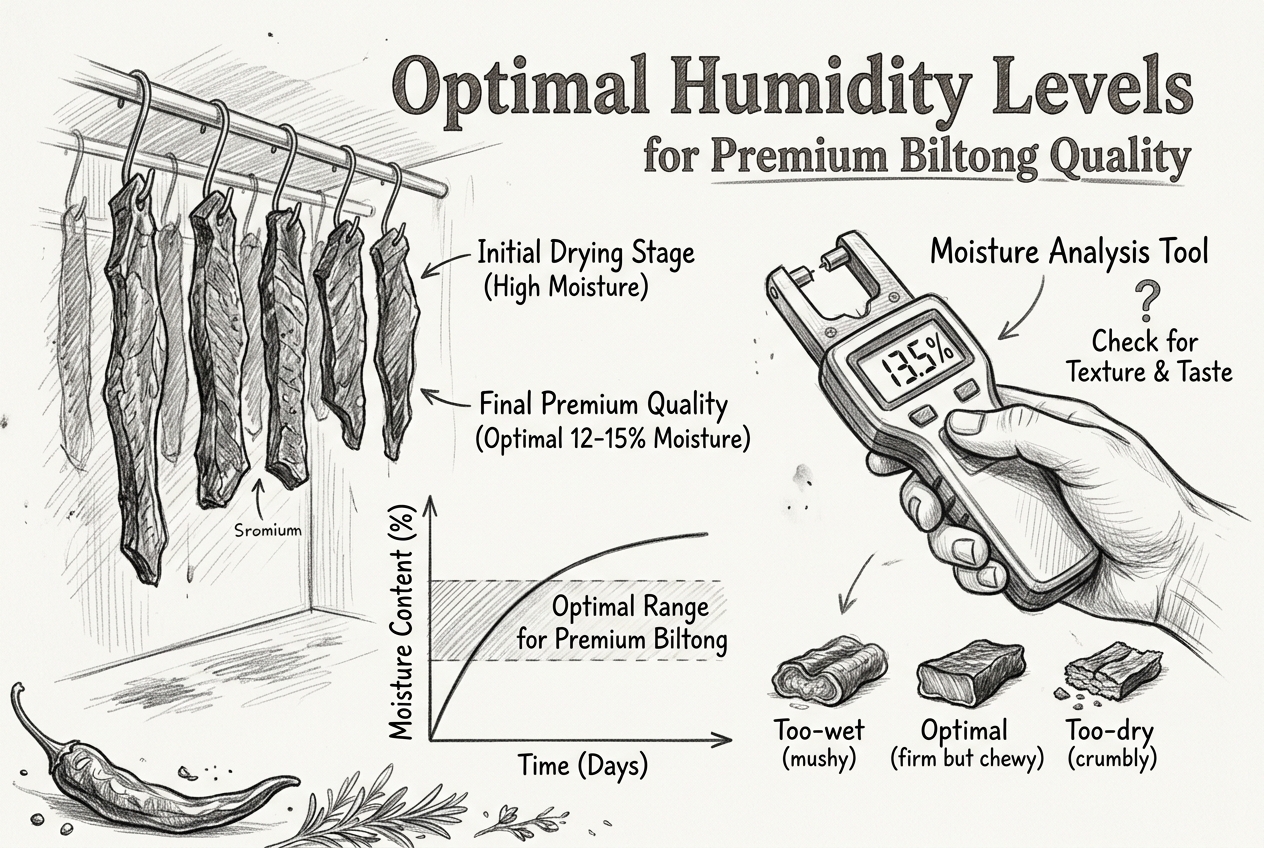
The difference between exceptional South African Beef Biltong and mediocre dried meat comes down to one critical factor: moisture content. You might think biltong production is simply about hanging strips of meat until they’re dry, but in reality it involves precise moisture management that distinguishes artisanal quality from mass-produced alternatives.
Professional biltong makers understand that achieving the perfect balance requires monitoring humidity levels with scientific precision. Too much moisture, and you risk spoilage or that unpleasant chewy texture nobody wants. Too little, and your biltong becomes brittle jerky that crumbles rather than offering that satisfying bite.
This moisture mastery becomes even more crucial when you consider that premium biltong commands significantly higher prices than standard dried meat products. Commercial producers who consistently nail their humidity control deliver products customers return for repeatedly.
The Science Behind Optimal Biltong Moisture Levels
Biltong requires a final moisture content between 15-25% to achieve that characteristic texture and flavor profile. Unlike jerky, which aims for much lower moisture levels, biltong maintains enough water activity to preserve its tender bite while remaining shelf-stable.
The water activity (aw) measurement tells the real story here. Premium biltong targets an aw level between 0.75-0.85, creating an environment where harmful bacteria cannot multiply while preserving the meat’s natural flavors. Professional producers monitor both moisture content and water activity because they don’t always correlate directly.
Temperature plays a supporting role in this moisture equation. Traditional air-curing methods rely on ambient temperatures between 18-24°C (64-75°F) with humidity levels around 55-65%. These conditions allow moisture to evaporate gradually while preventing case hardening, where the exterior dries too quickly and traps moisture inside.
The salt and vinegar curing process creates osmotic pressure that draws moisture from the meat fibers. This initial moisture extraction sets the foundation for controlled drying, but the subsequent air-curing phase determines final quality.
How Moisture Content Affects Biltong Texture and Shelf Life
Texture represents the most immediate impact of proper moisture management. Premium biltong should yield slightly to pressure while maintaining structural integrity. When you bite into properly cured biltong, it should require moderate chewing effort without being tough or requiring aggressive jaw work.
Shelf life directly correlates with the accuracy of moisture control. Biltong with 20% moisture content can maintain quality for 6-8 weeks when properly packaged, while products exceeding 25% moisture may develop mold within days. The relationship isn’t linear, though – biltong below 15% moisture becomes increasingly brittle and loses flavor complexity.
The thickness of your cuts significantly influences how moisture content affects final texture. Thin-cut biltong reaches optimal moisture levels faster but requires more precise monitoring to prevent over-drying. Thick-cut varieties offer more forgiveness during the curing process but demand longer drying times.
Fat content within the meat also impacts moisture behavior. Higher fat content creates natural moisture barriers that can lead to uneven drying if not properly managed. This explains why experienced producers carefully select their cuts of meat and strategically trim excess fat.
Traditional vs. Modern Moisture Testing Methods for Biltong Production
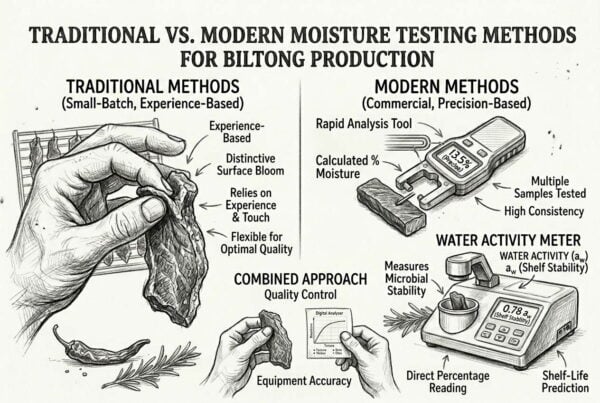
Comparison of traditional touch-based and modern digital methods for testing moisture levels in biltong production.
Traditional biltong makers relied on touch, appearance, and experience to determine readiness. They’d gently squeeze the meat, looking for specific flexibility characteristics and checking for the development of that distinctive surface bloom. This method worked for small-batch production but lacks the consistency required for commercial operations.
Modern moisture testing employs digital moisture analyzers that provide readings within minutes. These devices use halogen heating elements to rapidly extract moisture while calculating precise percentages. Professional producers typically test multiple samples from each batch to ensure uniformity.
Water activity meters represent another advancement in biltong quality control. These instruments measure the availability of water for microbial growth rather than total moisture content. A piece of biltong might test at 22% moisture content but have a water activity of 0.78, indicating excellent shelf stability.
Some commercial operations combine both approaches, using digital testing for quality control while training staff to recognize proper texture and appearance. This dual method approach reduces dependence on equipment while maintaining scientific accuracy.
Industry Standards: What Defines Premium Biltong Quality
Premium biltong producers typically target moisture content between 18-22% for optimal balance of texture, flavor, and shelf life. This range allows for slight variations based on meat selection and customer preferences while maintaining consistent quality standards.
Commercial food safety regulations often require documentation of moisture levels and water activity measurements for each production batch. These records help producers identify trends and make adjustments before quality issues develop.
The premium biltong market differentiates itself through consistent moisture management rather than simply achieving low moisture numbers. Customers pay premium prices for products that deliver the same texture and flavor experience every time they purchase.
Professional operations establish standard operating procedures that define acceptable moisture ranges for different product types. Whether you’re producing traditional biltong or specialized varieties, documented moisture standards ensure reproducible results that justify premium pricing.
Mastering the Biltong Drying Process: Environmental Controls for Consistent Results
Ideal Temperature and Humidity Combinations for South African Biltong
Getting the temperature and humidity balance right determines whether you’ll produce premium South African Beef Biltong or end up with leather-tough disappointment. The sweet spot is 15-20°C (59-68°F) with a relative humidity of 50-60%.
Professional biltong makers monitor these levels religiously because even small deviations can ruin entire batches. Temperatures above 25°C accelerate bacterial growth, while temperatures below 10°C slow the drying process to a crawl. You’re aiming for that Goldilocks zone where moisture evaporates steadily without creating conditions for spoilage.
Humidity deserves equal attention. Too high (above 70%) and your biltong won’t dry properly, which can lead to surface mold. Too low (below 40%) causes case hardening, in which the outer layer forms a tough shell while the interior remains moist. This creates the perfect environment for botulism and other nasties.
Smart producers use digital hygrometers placed at different levels in their drying rooms. Air naturally stratifies, so humidity can vary by 10-15% between the floor and the ceiling. Position your best cuts in the optimal zones you’ve identified through consistent monitoring.
Airflow Management Techniques in Professional Biltong Production
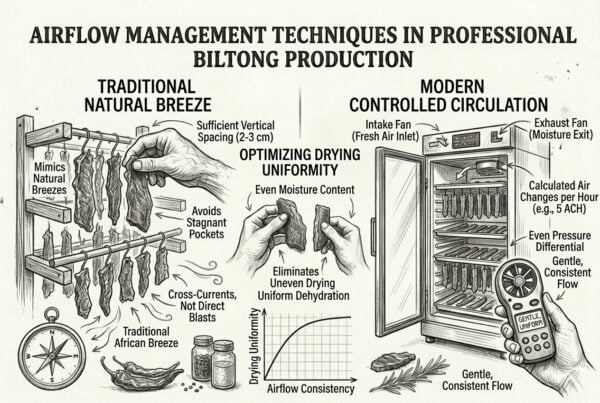
Comparison of traditional natural-breeze and modern controlled-airflow methods for achieving uniform biltong drying.
Static air kills biltong quality faster than bad spicing. Proper airflow removes moisture-laden air while preventing the stagnant pockets where bacteria thrive. The goal isn’t hurricane-force winds but gentle, consistent circulation that mimics natural African breezes.
Position fans to create cross-currents rather than direct blasts. Direct airflow causes uneven drying, with one side of your biltong strips becoming overly dehydrated while the other remains soft. Aim for 4-6 air changes per hour throughout your drying space.
Professional setups use intake and exhaust fans working in harmony. Fresh air enters from one side while moisture-laden air exits from the opposite end. This creates a gentle pressure differential that keeps air moving without causing turbulence that could damage delicate strips.
Don’t forget vertical spacing when hanging strips. Allow at least 2-3 centimeters between pieces so air can circulate freely around each strip. Overcrowding creates humid microclimates where individual pieces can’t dry properly, leading to inconsistent biltong moisture content.
Seasonal Adjustments: Adapting Your Drying Environment Year-Round
Mother Nature doesn’t care about your biltong production schedule. Summer humidity spikes and winter temperature drops require constant environmental adjustments to maintain consistent quality. Smart producers track seasonal patterns and adjust their processes accordingly.
Summer presents the biggest challenge with high humidity and temperature fluctuations. You’ll need dehumidification systems working overtime and potentially air conditioning to maintain optimal conditions. Some producers shift to night-time drying during peak summer months, when temperatures and humidity naturally moderate.
Winter brings different headaches. Low humidity sounds ideal, but it can cause excessive moisture loss, creating the dreaded case-hardening effect. You might need to add controlled moisture using humidification systems or by placing damp towels strategically in your drying area.
Rainy seasons require special vigilance. Atmospheric pressure changes affect drying rates, and increased moisture in incoming air can overwhelm your environmental controls. Professional facilities often have backup dehumidification systems specifically for these challenging periods.
The key lies in understanding your local climate patterns and preparing for seasonal shifts before they impact your production. Keep detailed records of environmental conditions and resulting biltong quality to identify trends and optimize your year-round processes.
Equipment Selection: Dehydrators vs. Traditional Hanging Methods
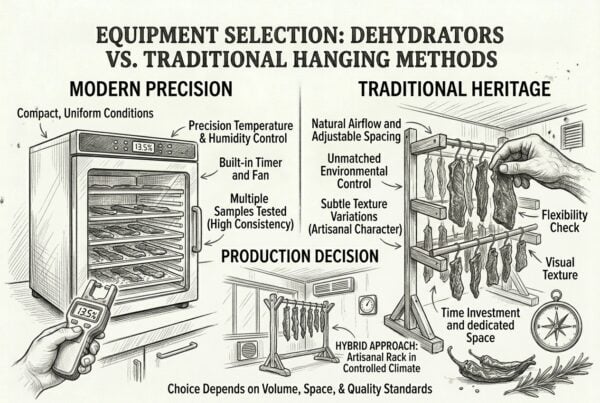
Modern dehydrators and traditional hanging methods compared for food drying efficiency, craftsmanship, and control.
The eternal debate between modern convenience and traditional methods shapes every serious biltong operation. Both approaches can produce exceptional results, but each demands different skills and offers distinct advantages.
Traditional hanging methods connect you directly to South African heritage while providing unmatched control over every environmental variable. You’re working with natural airflow, adjustable spacing, and the ability to monitor individual strips throughout the process. But this approach requires dedicated space, consistent environmental monitoring, and significant time investment.
Modern dehydrators offer precision control with built-in temperature and humidity management. They’re compact, energy-efficient, and produce consistent results regardless of external weather conditions. However, they limit batch sizes and can create uniform conditions that miss the subtle variations that make traditionally dried biltong special.
Consider hybrid approaches that combine traditional hanging with modern environmental controls. Many successful operations use climate-controlled rooms with traditional hanging systems, getting the best of both worlds. This allows for larger batches while maintaining the artisanal character that defines premium craft biltong.
Your choice ultimately depends on production volume, available space, and quality standards. Small-batch artisanal producers often prefer traditional methods for their flexibility and character. Large-scale operations typically favor controlled environments for consistency and food safety compliance.
Optimal Biltong Humidity Ranges: Achieving the Perfect Balance
Target Humidity Levels for Different Biltong Cuts and Thicknesses
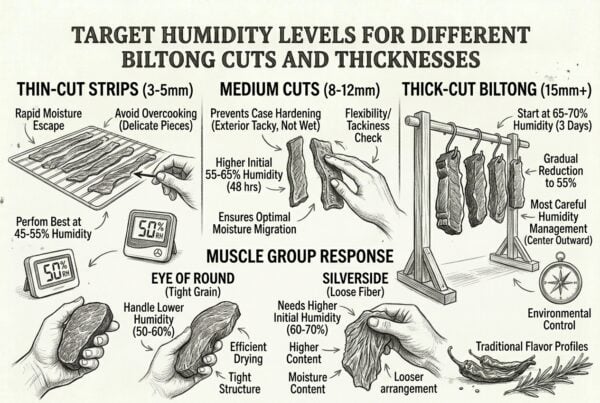
Guide showing ideal humidity levels for drying thin, medium, and thick biltong cuts with notes on muscle type and proper moisture balance.
The thickness of your biltong cut determines everything about your humidity strategy. Thin-cut strips (3-5mm) perform best at 45-55% humidity, allowing moisture to escape quickly without surface hardening. These delicate pieces can go from perfect to overcooked in hours if the humidity drops too low.
Medium cuts (8-12mm) require a slightly higher humidity level of 55-65% during the initial 48 hours. This prevents the dreaded case hardening, where the exterior dries too fast, trapping moisture inside. You’ll know you’ve got it right when the surface feels slightly tacky but not wet.
Thick-cut biltong (15mm and above) requires the most careful humidity management. Start at 65-70% humidity for the first three days, then gradually reduce to 55% as the drying progresses. The goal is to allow moisture to migrate from the center outward at a controlled pace.
Different muscle groups also respond differently to humidity. Eye of round cuts can handle lower humidity (50-60%) because of their tight grain structure. But silverside needs higher initial humidity (60-70%) due to its looser fiber arrangement and higher moisture content.
Monitoring and Adjusting Humidity During the Drying Cycle
Professional biltong makers check humidity levels every 4-6 hours during the critical first week. Digital hygrometers with data logging capabilities give you the control needed for consistent results. Place multiple sensors throughout your drying space to catch microclimates.
The first 72 hours are make-or-break for humidity control. Start checking every 2 hours if you’re new to this. Watch for condensation on chamber walls (humidity too high) or surface cracking on the meat (humidity too low). Both signals require immediate adjustment.
Natural humidity fluctuations happen throughout the day. Morning humidity typically runs 10-15% higher than afternoon levels. Plan your drying schedule around this pattern. Many commercial producers start their cycles in the evening to take advantage of naturally stable overnight conditions.
Airflow and humidity work together in the science of air-drying beef. Increase fan speed when humidity climbs above target ranges, but never exceed gentle circulation. Aggressive airflow at high humidity creates uneven drying patterns that ruin texture.
Emergency adjustments sometimes become necessary. If humidity spikes above 75%, immediately increase ventilation. When humidity crashes below 40%, mist the air lightly or add shallow water pans.
Common Humidity Mistakes That Compromise Biltong Quality
The biggest mistake new biltong makers commit is ignoring humidity completely. They focus on temperature and timing while moisture levels swing wildly. This creates that disappointing leathery texture that makes people think biltong is just tough jerky.
Overcorrecting humidity swings causes more problems than gradual adjustments. Dropping the humidity from 70% to 45% in a single adjustment shocks the meat and causes surface hardening. Make changes in 5-10% increments over several hours instead.
Using household dehumidifiers without proper control systems leads to over-drying disasters. These units often drop humidity too aggressively, creating biltong that crumbles rather than having that perfect chewy bite. Invest in variable-speed units with precise controls.
Many producers underestimate the impact of biltong spice blends on moisture retention. Salt draws out moisture aggressively, while sugar-based marinades can trap it. Adjust your humidity targets based on your spice mixture composition.
Loading drying chambers too heavily creates humidity pockets where air circulation can’t reach. Even perfect ambient humidity becomes useless when individual pieces can’t breathe. Leave 2-3 inches between hanging strips for optimal results.
Regional Climate Considerations for South African Biltong Makers
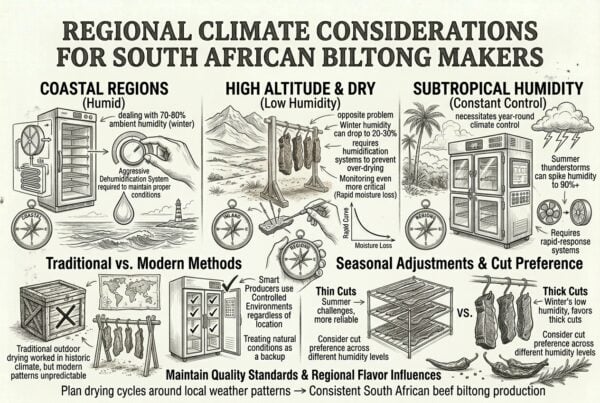
Infographic showing how south africa’s diverse climates influence biltong drying, with tips for humidity control and consistent flavor year-round.
Coastal regions face unique humidity challenges that inland producers never encounter. Maritime climate means dealing with 70-80% ambient humidity during the winter months. You’ll need aggressive dehumidification systems to maintain proper drying conditions.
High altitude and dry climate present the opposite problem. Winter humidity can drop to 20-30%, requiring humidification systems to prevent over-drying. The rapid moisture loss at high altitudes makes monitoring even more critical.
Subtropical humidity necessitates year-round climate control to ensure consistent production of South African beef biltong. Summer thunderstorms can spike humidity to 90%+ within hours, requiring rapid-response systems.
Traditional outdoor drying methods worked in South Africa’s historic climate, but modern weather patterns are less predictable. Smart producers now use controlled environments regardless of location, treating natural conditions as a backup rather than as the primary drying method.
Seasonal adjustments become crucial for maintaining quality standards. Plan your drying cycles around local weather patterns, and consider the impact of thin-cut vs. thick-cut biltong preferences across different humidity levels. Winter’s low humidity favors thick cuts, while summer’s challenges make thin cuts more reliable.
Quality Control Protocols: Testing and Measuring Biltong Moisture Content
Professional Moisture Meters vs. Visual Assessment Techniques
Professional moisture meters represent the gold standard for biltong quality control, providing precise readings that eliminate guesswork. Digital meat moisture analyzers can measure water activity levels with 0.01-point accuracy, giving you the exact data needed for consistent South African Beef Biltong production.
These meters typically use electrical resistance or capacitance methods to determine moisture content. Pin-type meters penetrate the meat’s surface to take internal readings, while pinless models scan from the outside. For biltong production, pin-type meters work better because they measure core moisture, where spoilage bacteria typically develop.
But you don’t always need expensive equipment to assess quality. Experienced biltong makers rely on proven visual and tactile methods that have worked for generations. The “bend test” remains one of the most reliable techniques – properly dried biltong should crack slightly when bent but not break completely.
Color changes tell their own story throughout the drying process. Fresh meat starts deep red, then darkens to mahogany as moisture evaporates. Surface mold (the white, chalky kind) actually indicates proper aging conditions, while green or black spots signal problems.
Touch and texture provide immediate feedback about moisture levels. Properly cured biltong feels firm but slightly pliable, never wet or sticky. The surface should be dry to the touch with no moisture beading when pressed.
Establishing Quality Checkpoints Throughout the Drying Process
Systematic quality checkpoints prevent problems before they compromise entire batches. Most commercial operations establish testing intervals every 12-24 hours during the critical first week of drying.
Day one checkpoints focus on initial moisture loss and surface conditions. You’re looking for even color development and the beginning of surface firming. Any pieces showing uneven drying or soft spots need to be repositioned or removed.
Days two through four represent the critical moisture reduction phase. Test samples from different hanging positions to ensure uniform drying conditions. Top-hung pieces often dry faster than bottom ones due to air circulation patterns.
The final checkpoint comes around day seven for traditional thickness cuts. Target moisture content should reach 40-45% for optimal texture and safety. This is where precision moisture meters prove their worth – visual assessment alone can’t guarantee food safety standards.
Smart producers also implement environmental checkpoints alongside product testing. Humidity swings above 70% or temperature drops below 15°C trigger immediate corrective actions to prevent quality issues.
Documentation and Tracking Systems for Consistent Production
Professional documentation systems transform biltong-making from an art into a reproducible science. Simple logbooks that track daily moisture readings, environmental conditions, and visual observations provide valuable production data.
Digital tracking systems offer significant advantages for larger operations. Bluetooth-enabled moisture meters can automatically log readings to smartphone apps, creating timestamp records without manual entry errors. These systems often include photo documentation features for visual quality tracking.
Batch tracking becomes crucial when scaling production beyond homemade biltong quantities. Each production run needs unique identifiers linking raw material sources, processing dates, and final quality metrics. This traceability proves essential for quality investigations and continuous improvement.
Environmental data logging provides context for variations in quality. Sudden spikes in humidity or temperature fluctuations often explain unexpected moisture retention or surface defects discovered days later.
The most successful operations maintain both digital and physical backup records. Equipment failures or software glitches can’t compromise months of valuable production data when proper backup systems are in place.
Troubleshooting Common Moisture-Related Quality Issues
Case hardening represents the most frustrating moisture-related problem in biltong production. The outer surface dries too quickly, forming a barrier that traps moisture inside. This creates perfect conditions for internal spoilage while the exterior appears properly cured.
High initial humidity (above 80%) frequently causes case hardening. The solution involves reducing ambient moisture levels during the first 48 hours when surface drying occurs most rapidly. Some producers use dehumidifiers or increase air circulation during this critical period.
Uneven drying creates quality consistency problems that affect customer satisfaction. Pieces from the same batch that show different moisture levels indicate issues with air circulation or hanging position. Rotating hanging positions every 24 hours often resolves these problems.
Surface moisture retention, even after extended drying periods, usually signals inadequate air movement or excessive ambient humidity. Proper storage becomes critical at this point to prevent further deterioration in quality.
White surface deposits sometimes concern new producers, but this natural bloom indicates beneficial mold development that enhances flavor complexity. However, any green, black, or fuzzy growths require immediate attention and typically mean starting over with that batch.
Over-drying creates its own problems, resulting in brittle, tough biltong that lacks the characteristic chewy texture customers expect. Recovery options are limited once moisture drops below 35%, making prevention through careful monitoring essential.
Advanced Moisture Management Strategies for Commercial Biltong Production
Scaling Up: Maintaining Consistency Across Large Batch Production
Managing biltong moisture content becomes exponentially more complex when you’re processing hundreds of kilograms rather than a few strips hanging in your garage. Commercial operations face the challenge of maintaining uniform quality across massive batches, where even small variations in humidity can create significant product inconsistencies.
The key lies in zone-based control systems. Smart producers divide their drying facilities into multiple controlled environments, each with its own temperature and humidity parameters. This approach allows for real-time adjustments without affecting entire production runs.
Load balancing plays a crucial role here. When hanging large quantities of meat, air circulation patterns change dramatically. What works for 20lbs of biltong won’t necessarily scale to 1000lbs. Professional operations invest in computational fluid dynamics modeling to understand airflow patterns and optimize hanging positions.
Batch tracking becomes essential at this scale. Each production run requires detailed moisture-monitoring logs, enabling operators to identify patterns and proactively adjust our processes. The most successful commercial operations maintain moisture content databases that inform future production decisions.
Integration with Food Safety Standards and HACCP Protocols
Optimal biltong humidity control isn’t just about taste and texture anymore. Food safety regulations demand precise documentation and control of moisture levels throughout the entire biltong drying process.
HACCP (Hazard Analysis Critical Control Points) protocols require specific moisture benchmarks at defined intervals. For biltong production, critical control points typically include initial moisture measurement, 24-hour checkpoints, and final product verification. These aren’t suggestions but legal requirements for commercial operations.
Water activity (aw) measurements become mandatory documentation. While traditional moisture content tells you how much water is present, water activity indicates how available that water is to harmful microorganisms. Commercial biltong must achieve aw levels below 0.85 to inhibit the growth of pathogenic bacteria.
Temperature logging systems must integrate seamlessly with moisture monitoring. Modern food safety standards require continuous data recording rather than periodic manual checks. This means investing in automated systems that can demonstrate compliance during regulatory inspections.
The documentation burden is significant but manageable with proper systems. Digital logging eliminates human error while providing the detailed records that food safety auditors require.
Cost-Effective Solutions for Small-Scale Artisan Producers
Not every biltong operation needs industrial-grade moisture management systems. Artisan producers can achieve excellent results with strategic investments in key areas rather than comprehensive automation.
Digital hygrometers with data logging capabilities offer the best value for small operations. These devices cost a fraction of commercial monitoring systems while providing the precision needed for consistent quality. Look for units that can export data to smartphones or computers for record-keeping.
Dehumidifiers represent the most impactful single investment for moisture control. A quality residential dehumidifier can transform an inconsistent drying environment into a predictable one. The key is choosing units with precise humidity settings rather than basic on/off models.
DIY monitoring solutions work surprisingly well for motivated producers. Arduino-based systems can create sophisticated monitoring networks for under $200. These setups provide real-time alerts and historical data tracking that rival commercial systems.
Batch size optimization reduces complexity without sacrificing quality. Smaller, more frequent batches allow for closer monitoring and faster response to environmental changes. This approach also reduces exposure to risk if moisture management problems occur.
Innovation in Moisture Control Technology for Modern Biltong Operations
The biltong industry is experiencing a technological revolution in moisture management. IoT sensors now provide real-time monitoring with smartphone alerts, transforming how producers manage their operations.
Predictive analytics systems analyze historical moisture data to forecast optimal drying conditions. These systems learn from past batches and can recommend adjustments before problems occur. The technology that once required data scientists is now available in user-friendly applications.
Automated climate control systems respond to moisture fluctuations faster than human operators ever could. Advanced units can adjust temperature, humidity, and airflow within minutes of detecting variations. This rapid response prevents the quality issues that manual monitoring often misses.
Energy efficiency improvements make advanced moisture control more accessible. Modern systems consume significantly less power while providing superior control compared to older generation equipment. The operational cost savings often justify the initial technology investment within the first year.
Remote monitoring capabilities allow producers to oversee operations from anywhere. Whether you’re managing multiple facilities or simply want peace of mind during overnight drying cycles, cloud-based monitoring systems provide unprecedented operational visibility.
The integration of artificial intelligence in moisture management is creating opportunities for even sliced biltong operations to achieve consistent, premium-quality results that were previously limited to large-scale industrial operations.
Preserving Quality: Storage and Packaging Considerations for Optimal Moisture Retention
Post-Drying Storage Methods to Maintain Ideal Moisture Levels
Once your biltong reaches the perfect moisture content (typically 35-45%), the real challenge begins. Proper storage becomes critical to maintaining that carefully achieved balance between texture and safety.
The biggest mistake producers make? Sealing biltong immediately after drying. This traps residual surface moisture and can lead to uneven distribution throughout the meat. Instead, allow freshly dried biltong to equilibrate for 12-24 hours in a controlled environment.
Temperature control during storage matters just as much as humidity. Store biltong at 15-20°C (59-68°F) to prevent moisture migration from warmer to cooler areas within your storage space. Higher temperatures accelerate moisture loss, while lower temperatures can cause condensation when the product returns to room temperature.
Professional producers use specialized storage rooms with controlled airflow. But even small-scale operations can benefit from simple solutions: perforated containers that allow gentle air circulation while preventing dust contamination work exceptionally well for maintaining South African Beef Biltong quality.
Packaging Solutions That Protect Against Moisture Migration
Your packaging choice directly impacts how long biltong maintains its optimal moisture content. Traditional brown paper bags allow continued moisture release (perfect for slightly over-dried pieces), while vacuum-sealed packages lock in existing moisture levels.
Barrier films with specific moisture vapor transmission rates offer the sweet spot. These materials prevent external humidity from affecting your product while allowing minimal internal moisture adjustment. Look for packaging with MVTR (Moisture Vapor Transmission Rate) values between 0.5-2.0 g/m²/day for biltong applications.
Modified atmosphere packaging takes protection further by replacing oxygen with nitrogen or carbon dioxide. This approach prevents oxidation while maintaining moisture equilibrium. The result? Biltong that retains its intended texture for months rather than weeks.
Single-serving portions solve another moisture management challenge. Large packages expose the entire batch to atmospheric moisture every time they’re opened. Smaller portions minimize this exposure, keeping unopened pieces at their optimal moisture content longer.
Extending Shelf Life Through Proper Moisture Management
Shelf life extension isn’t just about preventing spoilage (though that’s obviously important). It’s about maintaining the eating experience your customers expect throughout the product’s entire lifespan.
The relationship between moisture content and shelf life follows a predictable curve. Biltong with 40% moisture content typically maintains quality for 6-8 weeks when properly packaged. Drop that to 35%, and you can extend the shelf life to 10-12 weeks without significantly compromising texture.
But here’s where it gets interesting: different cuts respond differently to moisture management. Silverside maintains quality longer at slightly higher moisture levels (42-45%), while topside performs better at the lower end (35-38%). Understanding these nuances helps you optimize storage conditions for specific products.
Oxygen absorbers provide additional protection by creating an anaerobic environment. Combined with proper moisture control, they can extend shelf life by 30-40% compared to standard packaging methods. The investment in specialized packaging materials pays for itself through reduced waste and improved customer satisfaction.
Consumer Education: How to Maintain Biltong Quality at Home
Your responsibility doesn’t end when the customer leaves your store. Educating consumers about proper home storage protects your product’s reputation and ensures they experience biltong at its intended quality.
Most consumers store biltong incorrectly (usually in airtight containers in warm kitchens). Provide clear storage instructions: room temperature, moderate humidity, and breathable containers work best for most home environments. Refrigeration actually accelerates quality loss due to temperature cycling.
The “paper bag test” offers consumers a simple quality check. Fresh, properly stored biltong should feel slightly firm but give slightly under pressure. If it’s rock-hard, it needs slight moisture rehydration. If it feels soft or sticky, it’s lost too much moisture during storage.
For longer-term home storage, consumers can use the “bread slice method” (adding a single slice of bread to containers for 2-4 hours) to restore slight moisture to over-dried biltong. This traditional technique requires careful monitoring but effectively extends eating quality.
Quality biltong starts with understanding moisture content, but it’s perfected through proper storage and handling. Every step from production through consumption affects the final eating experience.
Ready to experience perfectly balanced biltong moisture content? Discover how traditional air-curing methods create the ideal balance of texture and flavor. Your taste buds will understand why moisture management makes all the difference in the quality of premium South African Beef Biltong.
Related Posts
- Why Biltong Is More Than Just Dried Meat
- What is Biltong?
- The Art of Thin-Cut vs Thick-Cut Biltong: Choosing Your Texture Preference
- From Field to Flavor: The Journey of South African Biltong Craftsmanship
- How South African Spices Define the Flavor of True Craft Biltong
- The Science of Air-Drying Beef: Why Biltong’s Texture Is Unmatched