Blog
Traditional Curing Versus Commercial Preservation What Makes South African Methods Superior

The Heritage Behind South African Meat Curing
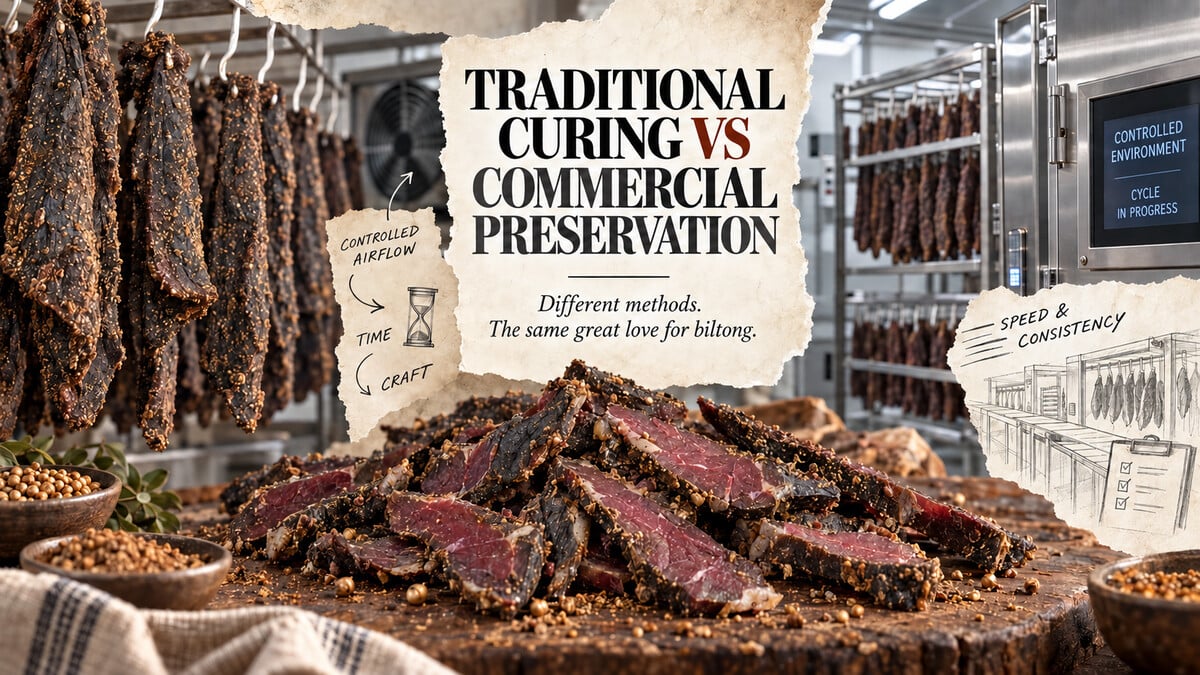
Walk into any specialty food market in Carlsbad or Escondido, and you’ll find shelves lined with protein snacks. Most of them arrive via industrial processes, vacuum-sealed and treated with additives designed to extend shelf life by months. But pick up a piece of South African beef, and you’re holding something fundamentally different. This isn’t a modern invention engineered in a lab. It’s a craft refined over centuries, born from necessity, geography, and an intimate understanding of how meat behaves when you let time do the work.
The difference between traditional curing and commercial preservation isn’t just about the final product. It’s about philosophy. One approach treats preservation as a problem to solve quickly with technology.
The other treats it as a process to respect, where patience and natural methods create something superior. Understanding where South African methods come from helps explain why they’ve endured while countless other preservation techniques have faded into history.
Origins of biltong and droëwors in settler culture
Biltong emerged in the 1650s when Dutch settlers arrived at the Cape of Good Hope. They brought cattle, knowledge of curing meats, and a pressing problem: how to preserve meat without refrigeration across vast distances and harsh climates. The solution they developed became biltong, a name likely derived from the Dutch words “bil” (rump) and “tong” (strip).
Early settlers couldn’t rely on modern preservation methods. They didn’t have factories or chemical additives. What they had was time, wind, and the African sun. They needed meat that could survive long treks through the interior, endure temperature swings, and remain edible for weeks or months. Biltong solved that problem, but more importantly, it tasted good doing it.
Droëwors followed a similar trajectory but with a different cut. While biltong typically uses whole muscle pieces, droëwors employs ground or minced meat, spiced heavily and dried in a tighter, sausage-like form. Both emerged from the same settler culture, both responded to the same environmental demands, and both have remained virtually unchanged in their fundamental process for over 350 years.
This longevity matters. When a technique survives that long, it’s because it works. It’s because generations of producers have tested it, refined it, and proven its superiority through repeated success. That’s not marketing. That’s history.
How climate and geography shaped traditional methods
South Africa’s interior plateau (the Highveld) creates specific conditions that make traditional air-curing ideal. Moderate temperatures, consistent airflow, and low humidity during much of the year create a natural drying environment that’s difficult to replicate elsewhere. Early producers didn’t choose to air-dry biltong because it sounded artisanal. They chose it because it worked better than any other method available.
The Cape’s Mediterranean climate in certain regions, combined with the Highveld’s inland conditions, offered something precious: natural, passive drying environments. You could hang meat strips from a tree or building and let the environment do what needed doing. No smoke required.
No constant fire management. No fuel costs. Just wind, time, and the meat’s own moisture leaving the muscle gradually, in a controlled way that preserved flavor compounds while removing the water that bacteria needed to survive.
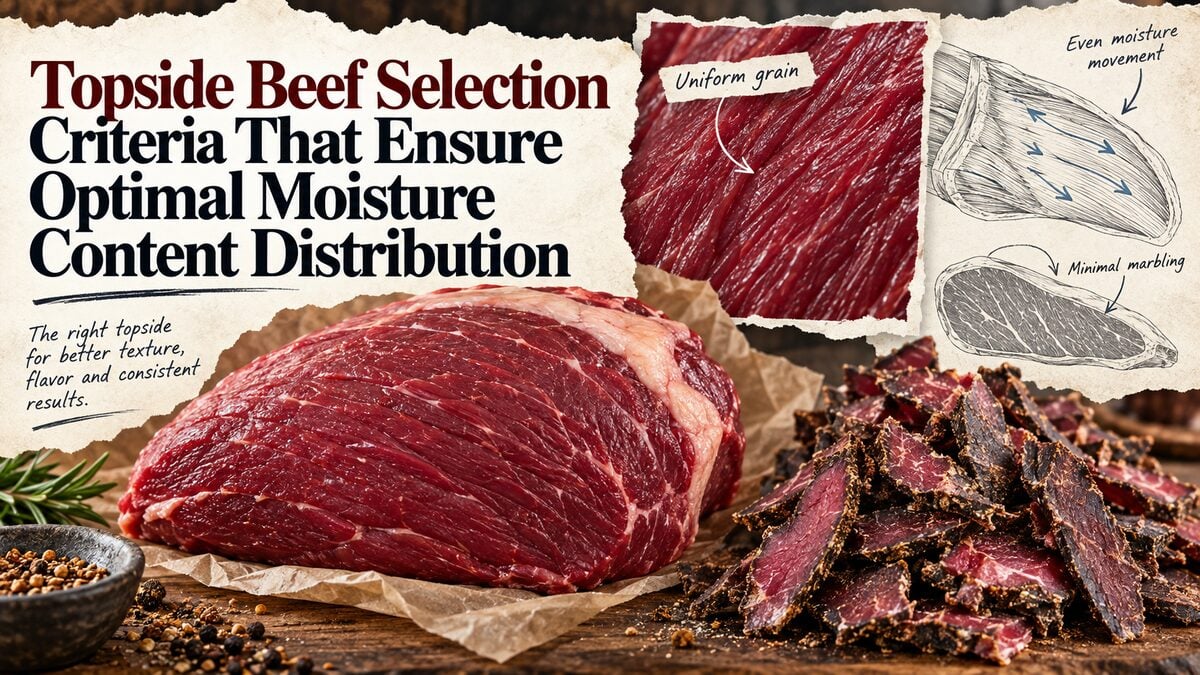
Geography also dictated what cuts worked best. The beef available to early settlers influenced which muscles they used, and those choices eventually became standardized. The traditional approach used silverside and topside cuts, selected for their shape, size, and muscle structure. These cuts dry evenly, creating the distinctive texture that defines traditional south african beef. Modern commercial operations can use any cut and manage the result with temperature control. Traditional methods required knowing which cuts would cooperate with the climate.
The role of time-honored techniques in flavor development
Speed is the enemy of flavor in traditional curing. Commercial preservation rushes the process. Heat accelerates dehydration. Chemicals arrest spoilage. The result reaches market quickly, but flavor compounds develop slowly, requiring time at controlled temperatures.
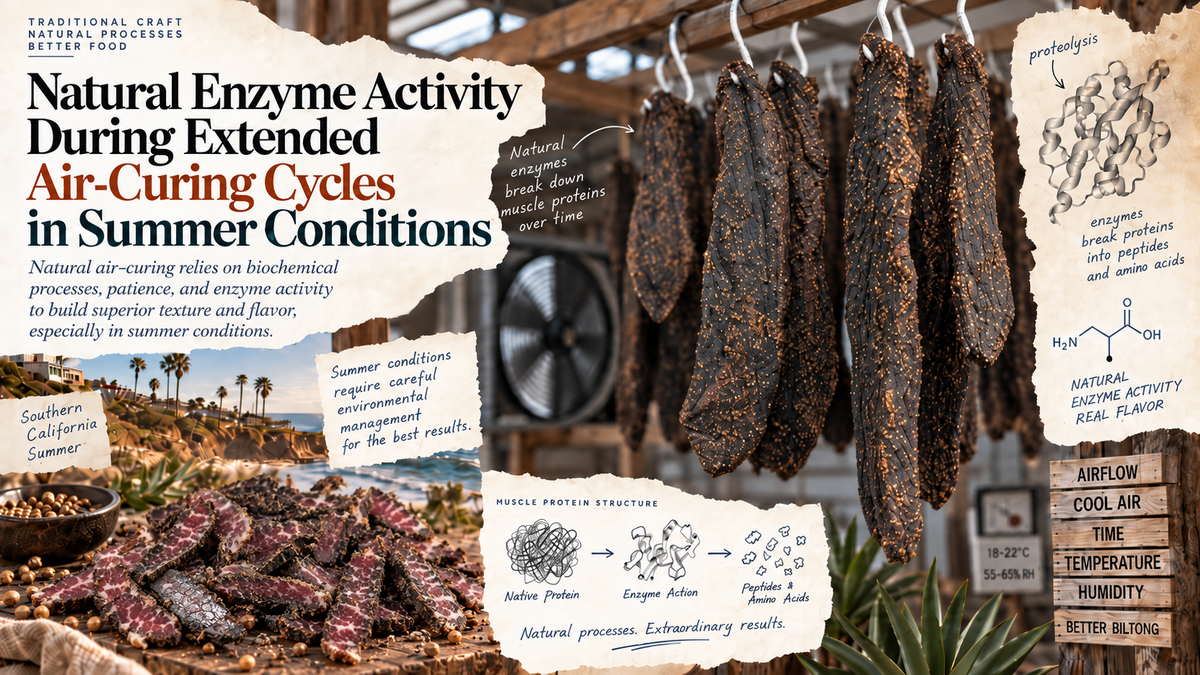
In contrast, traditional air-curing forces patience. A properly made biltong takes days, sometimes weeks. During this extended period, natural enzymes within the meat break down proteins into amino acids and peptides, creating complex flavors that commercial jerky can’t match. The science reveals that gentle, prolonged drying preserves these delicate compounds, while high-temperature processing destroys them.
The spice blends matter too. Traditional recipes use vinegar, salt, coriander, and pepper. No sugar. No liquid smoke. No preservatives beyond salt and the drying process itself. These simple ingredients work because the slow drying process allows them to penetrate deeply, becoming part of the final flavor rather than a surface coating.
This is why you can taste the difference. It’s not nostalgia. It’s chemistry. Traditional methods create superior flavor because they preserve the meat’s natural complexity while adding controlled, simple seasoning. That’s the heritage that makes South African methods superior.
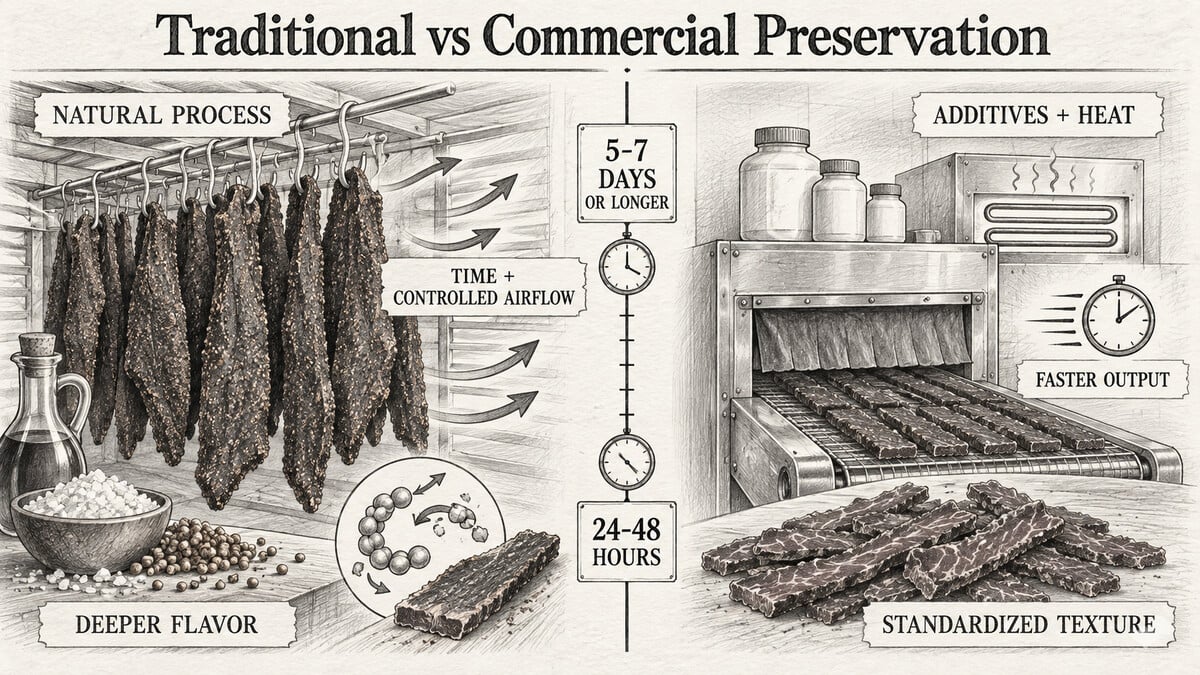
Traditional air-curing prioritizes gradual flavor development, while commercial processing prioritizes speed and consistency.
Key Differences Between Traditional and Commercial Preservation
Natural fermentation versus chemical additives
Here’s where traditional South African air-curing and commercial preservation diverge most sharply. Traditional biltong relies on natural fermentation, a process that happens quietly while the meat hangs in controlled conditions. Salt draws moisture from the muscle fibers, creating an environment where beneficial bacteria naturally develop. These microorganisms break down proteins into amino acids, building complex flavors and enhancing digestibility over time.
Commercial preservation takes a different route entirely. Most mass-market beef snacks depend on chemical additives like sodium nitrite, sodium nitrate, and various preservatives to extend shelf life and prevent bacterial growth. While these chemicals are FDA-approved and considered safe, they bypass the natural fermentation process altogether.
The result? Faster production, longer shelf stability, but a fundamentally different product.
The difference isn’t just about what’s added. It’s about what happens naturally when you give meat time and the right conditions. Traditional air-curing methods allow natural enzymes to work without interference, creating what the industry calls “clean preservation.” Your body recognizes these naturally developed compounds differently than chemically preserved proteins. When you’re looking at labels in your local Carlsbad or Escondido market, check whether you’re buying something fermented or something chemically stabilized.
Air-curing duration and its impact on quality
Time is the secret ingredient commercial producers don’t want to spend. Traditional South African biltong requires patience, typically hanging for 5 to 7 days minimum, sometimes stretching to two weeks depending on muscle thickness and environmental conditions. This extended duration allows moisture to escape gradually and consistently, creating that distinctive tender texture that sets air-cured beef apart from its commercially processed competitors.
Commercial processors rush this. High-temperature drying can reduce what takes a week down to 24 to 48 hours. Yes, you get a finished product faster, but you sacrifice quality in the process.
Rapid drying often locks in surface moisture before deeper muscle fibers have properly desiccated, creating an uneven texture. More importantly, you don’t get the flavor development that comes from proper curing duration.
When you compare the two side by side, the difference is immediate. A properly air-cured piece develops a tender that commercial quick-dried products simply can’t match. The longer duration allows spices like coriander and vinegar to penetrate deeper into the meat fibers, creating consistent seasoning throughout rather than surface flavoring. Quality takes time, and commercial operations have largely abandoned that equation.
Temperature control: passive methods versus artificial regulation
Traditional South African air-curing doesn’t rely on climate-controlled environments or automated temperature systems. Instead, craftspeople use centuries-old knowledge about natural ventilation, airflow patterns, and seasonal timing. In the arid regions where biltong originated, the naturally warm, dry climate creates ideal conditions without any artificial intervention. The process respects the environment rather than fighting against it with energy-intensive machinery.
Commercial facilities take the opposite approach. They install HVAC systems, temperature monitors, humidity regulators, and automated controls to create consistent conditions year-round. This consistency is their selling point: identical products regardless of season or location.
But here’s the trade-off. Artificial temperature regulation often means higher drying temperatures to speed production, which can denature some proteins and create a less tender final product. The gentle, naturally passive approach actually preserves more of the original meat’s nutritional integrity.
Consider the practical advantage for consumers. When you understand how traditional methods work, you realize why properly air-dried meat than heat-processed alternatives. The passive temperature control of traditional curing means the meat develops slowly, allowing complex chemical reactions to create depth of flavor. Commercial operations, reliant on artificial temperature management, prioritize speed and consistency over the nuanced results that come from respecting natural processes.
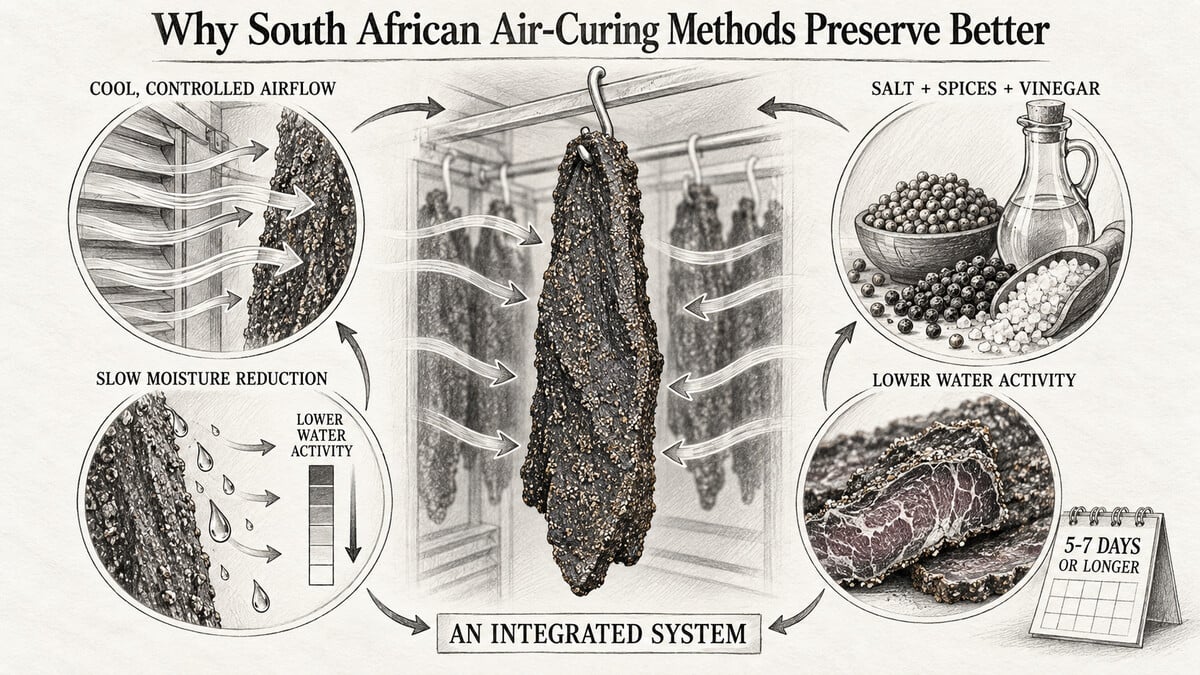
South African air-curing combines airflow, moisture reduction, traditional seasoning, and time as one preservation system.
Why South African Air-Curing Methods Preserve Better
Slow oxidation and natural moisture reduction
Here’s what most commercial preservation methods miss: they’re in a hurry. Traditional South African air-curing methods work on a completely different timeline. Instead of applying heat, chemicals, or aggressive processing, the process relies on slow oxidation and patient moisture reduction. This gradual transformation is exactly what preserves meat better than faster alternatives.
When you air-cure beef properly, oxidation happens at the surface first. The outer layer of the meat gradually loses moisture through exposure to controlled airflow and humidity. This isn’t random drying, though.
The process creates a protective exterior crust that seals in the interior moisture and flavor while preventing spoilage. Commercial methods often skip this natural barrier by using artificial preservatives and quick-drying techniques instead.
The science behind slow oxidation is straightforward but powerful. As moisture evaporates gradually, water activity (a measure of how available water is for bacterial growth) decreases naturally. Lower water activity means microorganisms can’t thrive.
Traditional biltong reaches shelf-stable status through this principle alone, without needing sodium nitrate, sodium nitrite, or other synthetic additives. The process typically takes 5 to 7 days, sometimes longer depending on thickness and environmental conditions. That patience pays off with superior preservation that lasts weeks without refrigeration.
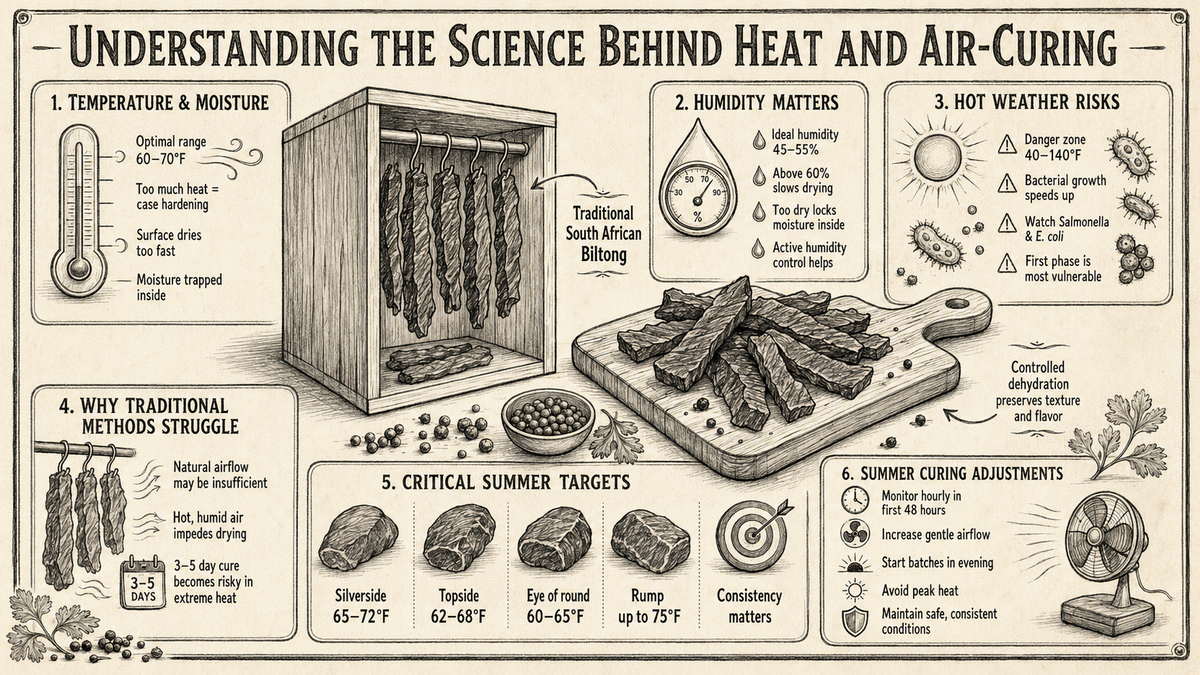
Temperature control during oxidation is critical here. South African methods maintain cooler, more stable conditions than commercial heat-processing. Gentler temperatures preserve the muscle fibers and protein structure better, which directly improves shelf life.
The meat doesn’t become brittle or over-processed. Instead, it maintains structural integrity that resists degradation over time. That’s why traditionally cured biltong stays fresher longer and doesn’t develop the cardboard texture you find in many commercial products.
How indigenous spice blends enhance preservation naturally
The spice blends used in traditional South African beef biltong aren’t just about flavor (though they absolutely deliver there). These time-tested combinations actually function as natural preservatives. Coriander, pepper, salt, and vinegar weren’t chosen randomly. Over centuries, South African craftsmen discovered which spices offered dual benefits: exceptional taste and genuine antimicrobial properties.
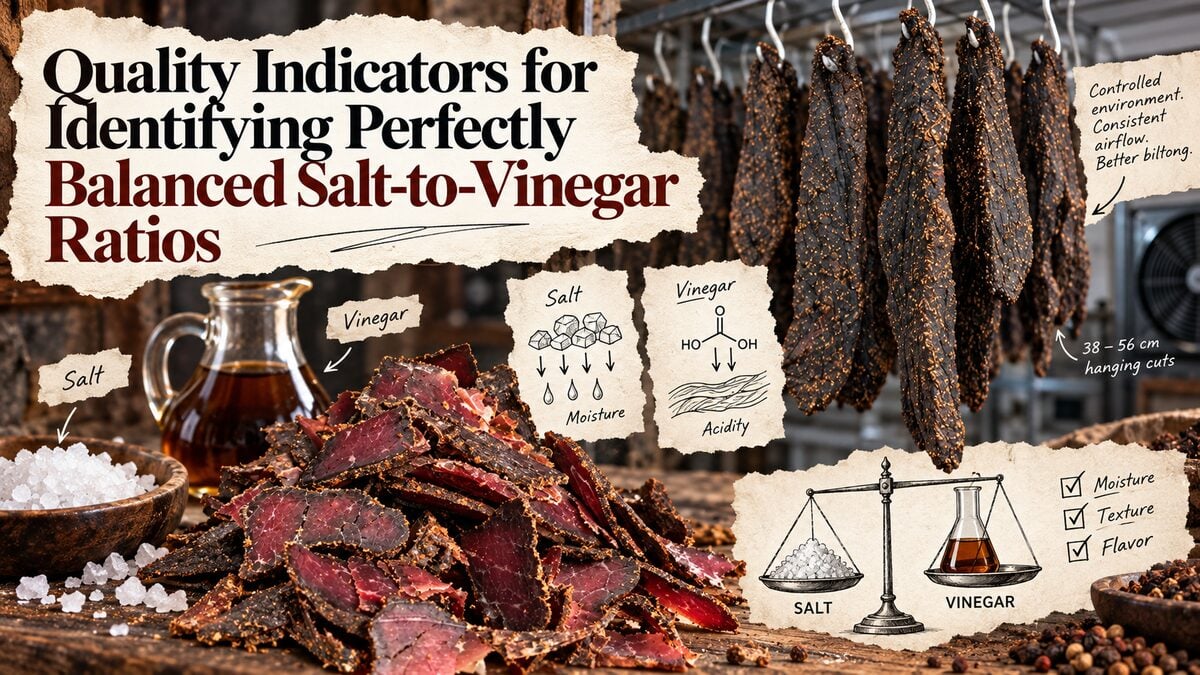
Salt is the foundation. It doesn’t just add flavor; it actively reduces water activity by binding to water molecules. This accelerates the preservation process without requiring modern chemistry.
Coriander seeds contain compounds with documented antibacterial properties. Black pepper and other spices contribute similar benefits. When you combine these in the traditional method, you create a preservation system that’s more effective than most people realize.
Vinegar plays a particularly sophisticated role in the curing process. It lowers pH, creating an acidic environment where harmful bacteria struggle to grow. This acidic environment works alongside salt and spices to create a culinary system. Commercial producers often replace this complexity with sodium benzoate or other synthetic preservatives. They’re choosing chemical shortcuts instead of respecting the wisdom embedded in traditional spice blends.
The beauty of indigenous spice combinations is that they’re proven. Generations of preparation across South Africa have refined these ratios. They work with the air-curing process to create cumulative preservation benefits that are genuinely superior to modern alternatives.
The science of beneficial mold and bacterial cultures in traditional curing
This might sound counterintuitive, but beneficial mold growth is actually a sign of proper traditional curing. The surface of air-cured biltong develops a thin, white mold layer during the process. This isn’t contamination.
It’s evidence that the curing environment is working correctly. These beneficial fungi consume residual oxygen and produce compounds that further inhibit harmful microorganism growth.
Certain bacterial cultures thrive naturally in the cool, acidic, salt-rich environment of traditional curing. Lactic acid bacteria, for example, ferment small amounts of carbohydrates (from the spices and meat) and produce additional organic acids. This acidification strengthens preservation while creating complexity in flavor. Commercial methods eliminate this entirely by relying on pasteurization and chemical additives.
The microbial ecosystem in traditionally cured meat is actually working for you. Lactobacillus and other beneficial cultures outcompete dangerous pathogens like E. coli or Listeria. This competitive exclusion is a natural preservation mechanism that food scientists have studied extensively. Traditional South African methods harness this principle without manipulation or synthetic intervention.
Understanding this science reveals why traditional air-curing genuinely preserves better. It’s not just moisture reduction or spices or slow oxidation working independently. It’s an integrated system where every element reinforces the others.
Commercial preservation strips away most of these protective mechanisms in exchange for speed and convenience. That’s the trade-off nobody talks about, but it’s exactly what makes South African methods genuinely superior.
Flavor and Nutritional Advantages of Traditional Techniques
Complexity of taste achieved through extended curing periods
Time changes everything when it comes to flavor. Traditional air-curing methods give South African beef biltong weeks to develop what commercial processes rush through in hours. This isn’t just about patience. It’s about chemistry.
When you cure meat using traditional methods, natural enzymes work quietly on the muscle fibers. Proteolysis breaks down complex proteins into amino acids and peptides. These smaller compounds create depth, umami, and layered flavors that taste buds actually register as “this is something special.” Commercial preservation often skips this phase entirely, relying on quick heat or chemical additives to lock in a flavor profile that feels flat by comparison.
South African spice blends, typically coriander, pepper, and salt, penetrate slowly into the meat during extended curing. The vinegar marinade works with the salt to create an acidic environment where flavor compounds become more bioavailable. What you taste isn’t just spice applied to the surface. It’s a flavor that’s been integrated into the protein itself over days and weeks.
Compare this to commercial beef snacks that rely on smoke flavoring, soy sauce derivatives, or artificial seasoning compounds to hit taste targets quickly. They work. They taste like something.
But they lack the complexity that comes from time. Traditional air-curing creates what the industry calls “layered flavor development.” First bite tastes different from the last bite because the curing process created multiple flavor compounds that release at different rates.
Preservation of amino acids and nutrients without processing
Here’s what matters to people actually eating this: nutrients stay intact. Traditional air-curing methods don’t expose meat to high heat. They don’t require chemical preservatives. They don’t strip away the nutritional value through processing.
Amino acids are fragile. Heat denatures them. Heavy processing damages them.
When you use traditional air-drying temperatures, you’re looking at ambient or slightly cool conditions where the meat gently loses moisture without thermal stress. Proteins remain stable. Essential amino acids like leucine, isoleucine, and valine stay in their native form, making them more readily available for muscle synthesis and recovery.
Commercial preservation often involves temperatures between 160 and 180 degrees Fahrenheit. At these levels, some amino acid structures change. Lysine availability decreases.
The biological value of the protein declines slightly (though it remains respectable). Traditional South African air-curing maintains temperatures in the 50 to 75 degree Fahrenheit range, depending on season and location. Protein quality stays superior.
Vitamins and minerals also benefit. B vitamins, particularly B12 and niacin, survive the gentle drying process intact. Iron content isn’t affected by oxidation the way it can be in high-heat processing. When you’re eating healthy beef snacks, you want the full nutritional profile working for you, not a compromised version.
Why artisanal methods create superior snacking experiences
Texture tells a story. Artisanal biltong achieves a texture that commercial methods can’t replicate. The slow, controlled drying process creates meat that’s tender but with character. It has chew. It has resistance. It requires engagement from the person eating it.
Commercial jerky often becomes brittle or overly hard because speed-drying forces all moisture out rapidly. Artisanal methods remove moisture gradually, allowing collagen and muscle fibers to contract in a way that preserves some structural integrity. The result is air-dried protein that’s genuinely satisfying to eat.
There’s also the sensory experience beyond flavor and texture. Artisanal producers in South Africa have been perfecting these techniques for generations. The craftsmanship shows in consistency, in quality control that comes from skill rather than machines, in attention to detail that commercial operations simply can’t maintain at scale. When you eat traditional biltong, you’re tasting that care.
This superiority extends to how your body processes it. Slower mastication leads to better satiety signaling. Better nutrient absorption happens when you’re actually breaking down the meat properly, not swallowing pre-processed bits. The snacking experience becomes functional and enjoyable simultaneously. That’s something commercial preservation struggles to achieve.
The Cost and Sustainability of Time-Honored Practices
Long-term value compared to mass-produced alternatives
When you buy a bag of commercial beef jerky at a gas station, you’re getting convenience. When you invest in traditional South African air-cured biltong, you’re getting longevity. There’s a meaningful difference between these two purchasing decisions, and it comes down to what happens after you open the package.
Commercial preservation methods rely on additives, accelerants, and processing techniques designed to maximize shelf life predictability and minimize production costs. This means faster turnover, higher profit margins, and products engineered to move through retail channels quickly. Traditional air-curing methods, by contrast, create a snack that actually improves slightly with time (when stored properly) and maintains its structural integrity far longer than mass-produced alternatives.
Consider the practical economics. A traditionally cured biltong product retains its flavor profile, texture, and nutritional density for weeks. Commercial jerky often becomes brittle or develops off-flavors within days of opening.
You’re not just paying for the initial purchase with traditional methods; you’re paying for a product that delivers value across multiple snacking occasions. This translates to fewer packages needed, less waste, and better cost-per-serving economics over time.
There’s also the sustainability angle embedded in pricing. While traditional biltong may cost slightly more upfront, the reduced need for replacement purchases and the minimal packaging waste means your total environmental and financial investment remains lower. Understanding how traditional biltong craftsmanship impacts long-term value helps you make purchasing decisions that benefit both your wallet and your pantry’s efficiency.
Minimal waste and environmental impact of traditional curing
The environmental footprint of commercial preservation extends far beyond what most consumers realize. Mass production requires temperature-controlled industrial facilities running 24/7, synthetic packaging materials designed for extended shelf stability, and distribution networks that demand controlled atmospheres. Every step amplifies energy consumption and waste generation.
Traditional air-curing methods operate differently. You’re leveraging natural environmental conditions: ambient air circulation, seasonal temperature variations, and humidity levels that exist regardless of production. No climate-controlled vacuum-sealing chambers.
No synthetic preservatives requiring chemical synthesis and packaging. Just natural processes working in harmony with the product itself.
The packaging story matters here too. Traditionally cured biltong requires minimal protective wrapping because the product doesn’t degrade rapidly. Commercial jerky needs multilayered barriers, oxygen absorbers, and moisture barriers to maintain shelf stability.
Those materials accumulate in landfills. Traditional methods reduce packaging volume significantly, meaning fewer resources consumed per unit produced and substantially less waste generated.
There’s also the matter of ingredient sourcing. Commercial preservation requires additives sourced from industrial chemical suppliers, often involving complex supply chains with their own environmental costs. Traditional spice-based seasoning and natural salt curing rely on simple, renewable ingredients. The difference in carbon footprint is substantial when you trace ingredients from source to finished product.
In regions like Carlsbad and Escondido, where water conservation and environmental responsibility shape community values, choosing traditionally preserved products aligns your purchasing power with local priorities. You’re supporting production methods that respect environmental boundaries rather than circumventing them through industrial processing.
Supporting local producers and traditional knowledge
When you buy air-cured biltong from traditional producers, you’re not just purchasing a snack. You’re making an economic choice that reinforces cultural heritage and keeps artisanal knowledge alive. Commercial operations consolidate production into large facilities and standardize processes. Traditional practitioners maintain the deep, generational knowledge that defines quality.
This matters because expertise gets lost when production scales. A master biltong producer understands how humidity shifts affect drying rates, how specific cuts require individualized attention, and how minor seasoning adjustments create nuanced flavor development. These insights come from decades of practice, often passed through families and communities. When you support traditional producers, you’re preserving that knowledge for future generations.
Local artisanal producers in South African communities depend on direct sales and reputation-based business models. They cannot afford to cut corners with additives or shortcuts because their livelihoods rest on consistent quality and customer loyalty. This creates alignment between producer incentives and consumer interests that rarely exists in commercial operations.
Supporting these producers also means supporting sustainable agricultural practices. Small-scale operations typically work with local farmers who maintain herd health through proper nutrition and humane practices, creating superior meat quality from the starting point. When you understand how distinct south, you recognize the cultural and economic significance embedded in each purchase.
By choosing authentic traditional biltong, you’re participating in an economic model that values craftsmanship over volume, quality over convenience, and community over consolidation. That’s an investment with returns that extend far beyond your personal health and satisfaction.
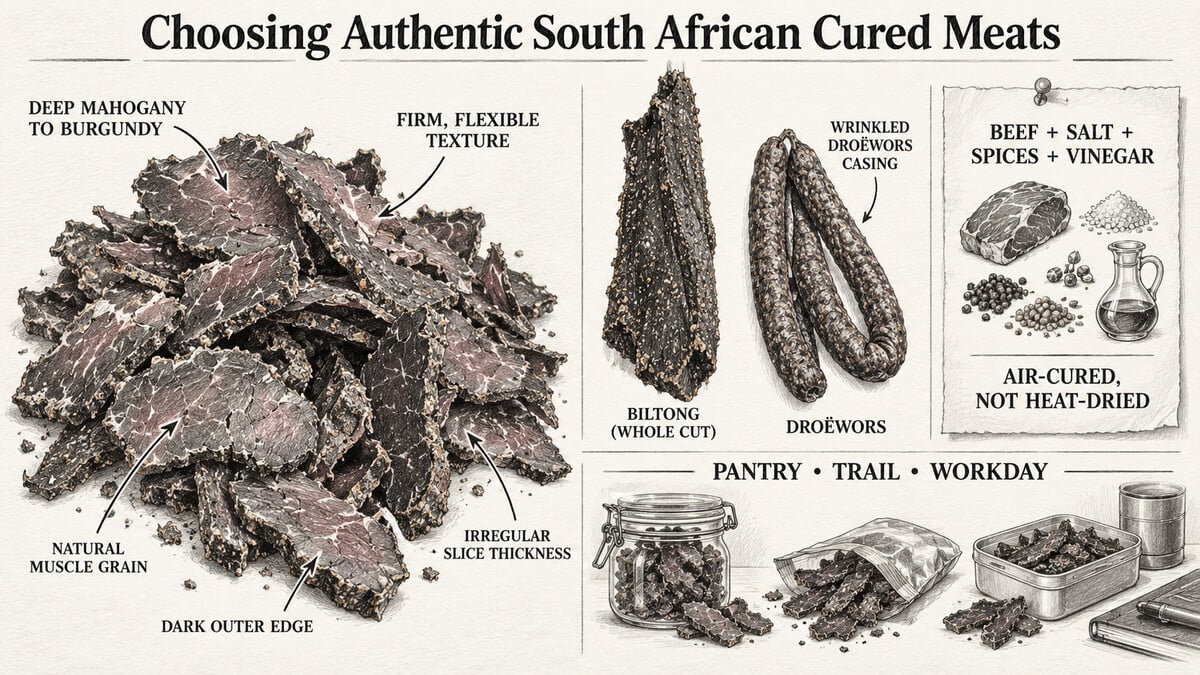
Authentic South African cured meats reveal their quality through natural color, texture, ingredients, and air-cured appearance.
Choosing Authentic South African Cured Meats
How to identify genuinely traditional biltong and droëwors
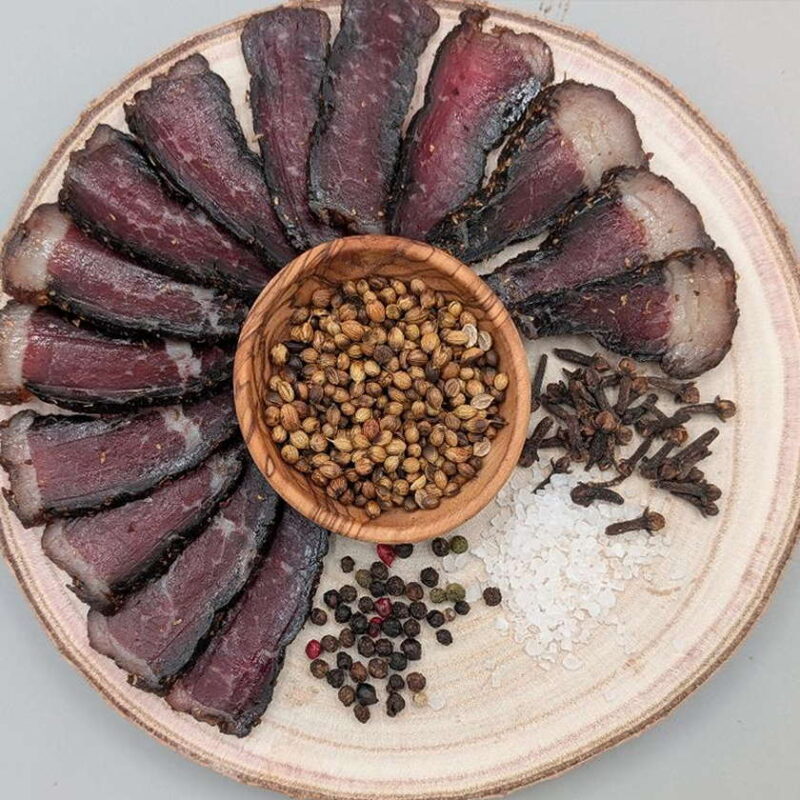
Spotting authentic South African beef biltong and droëwors takes a trained eye, but the signs are unmistakable once you know what to look for. Genuine traditional biltong has a deep mahogany to burgundy color, never bright red. That vibrant hue signals artificial curing accelerators or excess nitrates designed to speed up commercial production.
The surface texture should be slightly weathered and firm, with visible muscle fiber definition. When you bend a piece, it should flex without cracking completely, showing the moisture balance that only proper air-curing creates.
Droëwors, by contrast, should have a wrinkled skin from slow dehydration, never a glossy sheen. That wrinkle pattern is the calling card of traditional air-drying methods where humidity and airflow work together over weeks, not days. The aroma matters too.
Authentic biltong carries distinct spice notes (coriander, pepper, garlic) layered beneath beefy richness. Commercial versions often smell predominantly of salt and smoke, lacking the complexity that develops naturally during proper curing.
Texture tells the full story. Bend a slice of real traditional biltong and it should give slightly, then recover. Industrial jerky or hastily dried biltong shatters or powders because high-heat processing damages muscle protein structure. The science preserves amino acid chains intact, creating that signature tender-yet-substantial chew that commercial methods simply cannot replicate.
What to look for on ingredient labels and sourcing
Read ingredient lists like they’re contracts. Traditional South African biltong should contain exactly what you’d expect: beef, salt, spices, and vinegar. That’s it. If the label reads like a chemistry textbook with sodium nitrite, sodium erythorbate, artificial smoke flavoring, or preservatives you can’t pronounce, you’re holding a commercial product wearing traditional clothing.
Sourcing matters enormously. Ask where the beef comes from. Premium traditional makers source from specific cuts, typically silverside or topside, because those muscles develop the complex flavor profile the curing process needs to work with. Commercial producers buy whatever’s cheapest and mask inferior meat quality with aggressive seasoning or smoke injection.
Look for transparency about the curing process itself. Does the label mention air-drying timeframes or humidity control? Real producers share these details because they’re proud of them. Biltong differs fundamentally in methodology, and that distinction should be evident in how makers communicate their craft. Check whether they list vinegar type (traditional makers use quality apple or malt vinegar). The spice list should feel like a South African kitchen, not an industrial flavoring depot.
Small-batch producers in places like Carlsbad and Escondido who specialize in traditional methods often provide detailed sourcing stories because that heritage is their competitive advantage and their pride. Trust makers willing to explain every step.
Building a pantry with quality air-cured snacks for adventure and everyday enjoyment
Once you’ve learned to identify authentic traditional biltong and droëwors, the fun part starts: building a snack arsenal that actually works for your life. Quality air-cured snacks deserve a place in your regular rotation, not relegated to occasional treats. Unlike commercial jerky that leaves you thirsty and unsatisfied, proper traditional biltong sustains you through long workdays, trail adventures, or those moments when you need real protein without the crash.
Start by choosing variety. Traditional biltong comes in different thicknesses and spice profiles. Thicker cuts work brilliantly for extended hiking or travel because they require more chewing, keeping you satisfied longer.
Thinner slices suit office desk snacking or post-workout refueling when you want quick satisfaction. Droëwors works differently entirely, offering sausage texture with the same air-cured purity. Having both options means your pantry adapts to genuine need, not impulse.
Consider storage and shelf life as practical advantages. Because traditional air-curing develops natural preservation through moisture reduction and spice complexity, your pantry stock lasts. You’re not racing to eat product before it degrades like commercial brands require. Our blog explores regularly, but the short version is that quality air-cured snacks thrive in normal pantry conditions without requiring refrigeration or chemical preservatives.
The real payoff comes when you stop thinking of biltong as a specialty item and start treating it like the superior snack option it genuinely is. Quality air-cured South African beef biltong has earned its place in your daily life, not because it’s trendy or imported, but because traditional methods create nutritional density and satisfaction that commercial preservation simply cannot match. Whether you’re fueling an active lifestyle or seeking clean protein for everyday wellness, authentic traditional biltong delivers what your body actually needs.
Related Posts
- What is Biltong?
- Craving a Snack Makeover? Introducing Biltong: Healthy Deliciousness!
- Read On to Know How Biltong Differs From Beefy Jerky As A Meat Snack
- Healthy Beef Snacks: Hearty, and Heavenly
- Biltong: It’s More Versatile than You Think!
- Biltong vs. Jerky: What’s the Difference?
- A Culinary Journey into Biltong and Droëwors
- Biltong vs Jerky 2025: Why Air‑Dried Protein Leads Healthy Snacking Trends
- How South African Spices Define the Flavor of True Craft Biltong
- The Science of Air-Drying Beef: Why Biltong’s Texture Is Unmatched
- Droëwors vs Boerewors: Understanding Distinct South African Meat Snacks
- From Field to Flavor: The Journey of South African Biltong Craftsmanship